Responsible AI on AI-901: Microsoft's 6 Guiding Principles Explained
The six Microsoft responsible AI principles tested on AI-901 objective 1.1, with plain-English examples and the scenario cues the exam uses.
Responsible AI is the one topic on AI-901 that trips up technically strong candidates, because it isn't about Azure features — it's about principles. Objective 1.1 of Microsoft Azure AI Fundamentals asks you to describe the principles of responsible AI, and exam questions usually give you a scenario and ask which principle applies. This post walks through all six, with the kind of plain-English examples the exam rewards.
Why Microsoft tests responsible AI
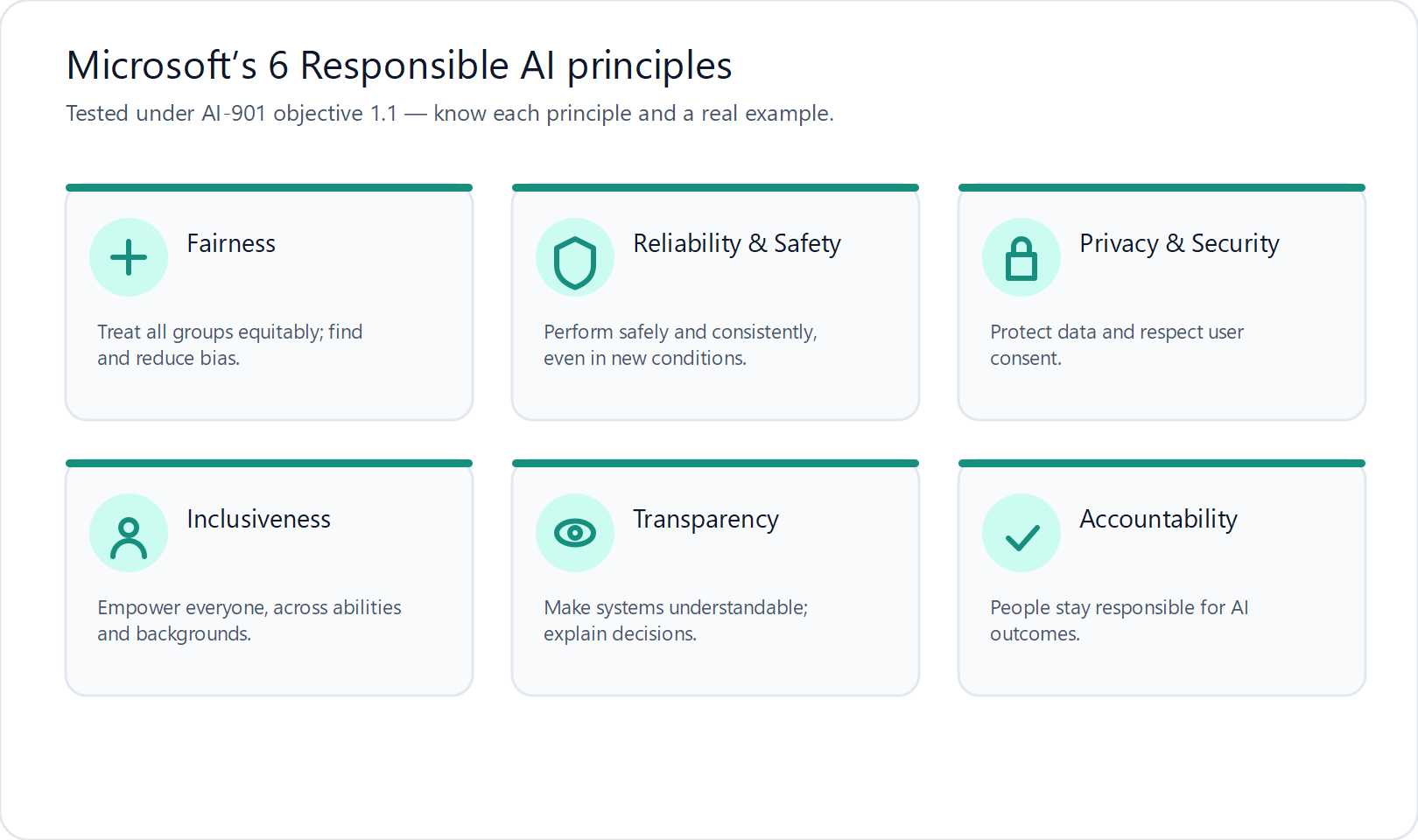
Microsoft frames responsible AI as a set of six principles that guide how AI systems should be designed and operated. On AI-901 you don't need to recite definitions word-for-word — you need to recognize which principle a situation is about. Learn them as “what problem does this prevent?”
The 6 principles, with examples
1. Fairness
AI systems should treat all people equitably and avoid reinforcing bias. Exam cue: a hiring model that scores one demographic lower, or a loan model trained on skewed data — that's a fairness problem.
2. Reliability & Safety
Systems should operate consistently and safely, including in unexpected conditions. Exam cue: a self-driving feature behaving unpredictably in bad weather, or a model that needs rigorous testing before release.
3. Privacy & Security
AI must protect personal data and respect consent. Exam cue: anything about securing training data, anonymizing records, or limiting who can access a dataset.
4. Inclusiveness
AI should empower everyone, regardless of ability or background. Exam cue: designing for accessibility — captions, screen-reader support, or serving users in many languages.
5. Transparency
People should understand how an AI system works and why it made a decision. Exam cue: explaining a model's limitations to users, or making it clear when someone is interacting with AI.
6. Accountability
People — not the model — remain responsible for AI outcomes, with governance and oversight in place. Exam cue: a framework that assigns human responsibility and review for an AI system's decisions.
A memory trick
Use the initials F-R-P-I-T-A (Fairness, Reliability, Privacy, Inclusiveness, Transparency, Accountability). Make up one sentence for each and you'll handle every 1.1 question. Watch for the two pairs that get confused: transparency (can you understand it?) vs accountability (who is responsible for it?), and fairness (equitable treatment) vs inclusiveness (accessible to all).
Quick self-check
Q: A bank deploys a credit model and must be able to tell a declined customer which factors drove the decision. Which principle is this? A: Transparency. (If the question instead stressed who answers for the decision and the governance around it, the answer would be accountability.)
Start practicing AI-901 questions for free
Reading about the objectives gets you maybe halfway. The concepts only stick once you answer real questions, get one wrong, read why, and try again. That feedback loop is what actually moves your score on exam day.
Responsible AI is pure pattern-matching once you've seen enough scenarios. On ExamStudyApp you can run a free AI-901 practice session right now — no account and no credit card required. You'll see Microsoft Azure AI Fundamentals questions one at a time with a full explanation after every answer, so each question doubles as a mini lesson.
When you're ready to go all in, the Microsoft Azure AI Fundamentals (AI-901) practice tests give you unlimited adaptive practice plus timed, full-length mock exams that mirror the real scoring — including a per-objective breakdown so you know exactly what to review before you book the exam.
▶ Try free AI-901 practice questions →
The full AI-901 series
This post is part of our five-part AI-901 study series:
- AI-901 Exam Guide (2026): What's New in Azure AI Fundamentals
- Responsible AI on AI-901: Microsoft's 6 Guiding Principles (you are here)
- Microsoft Foundry for AI-901: Generative AI Apps & Agents
- Azure AI Services on AI-901: Vision, Speech & Document Intelligence
- How to Study for AI-901: A 14-Day Azure AI Fundamentals Plan