Terraform Environments Explained: Dev, Staging, and Prod
Learn how teams manage dev, staging, and production with Terraform using separate state, variables, modules, and promotion workflows.
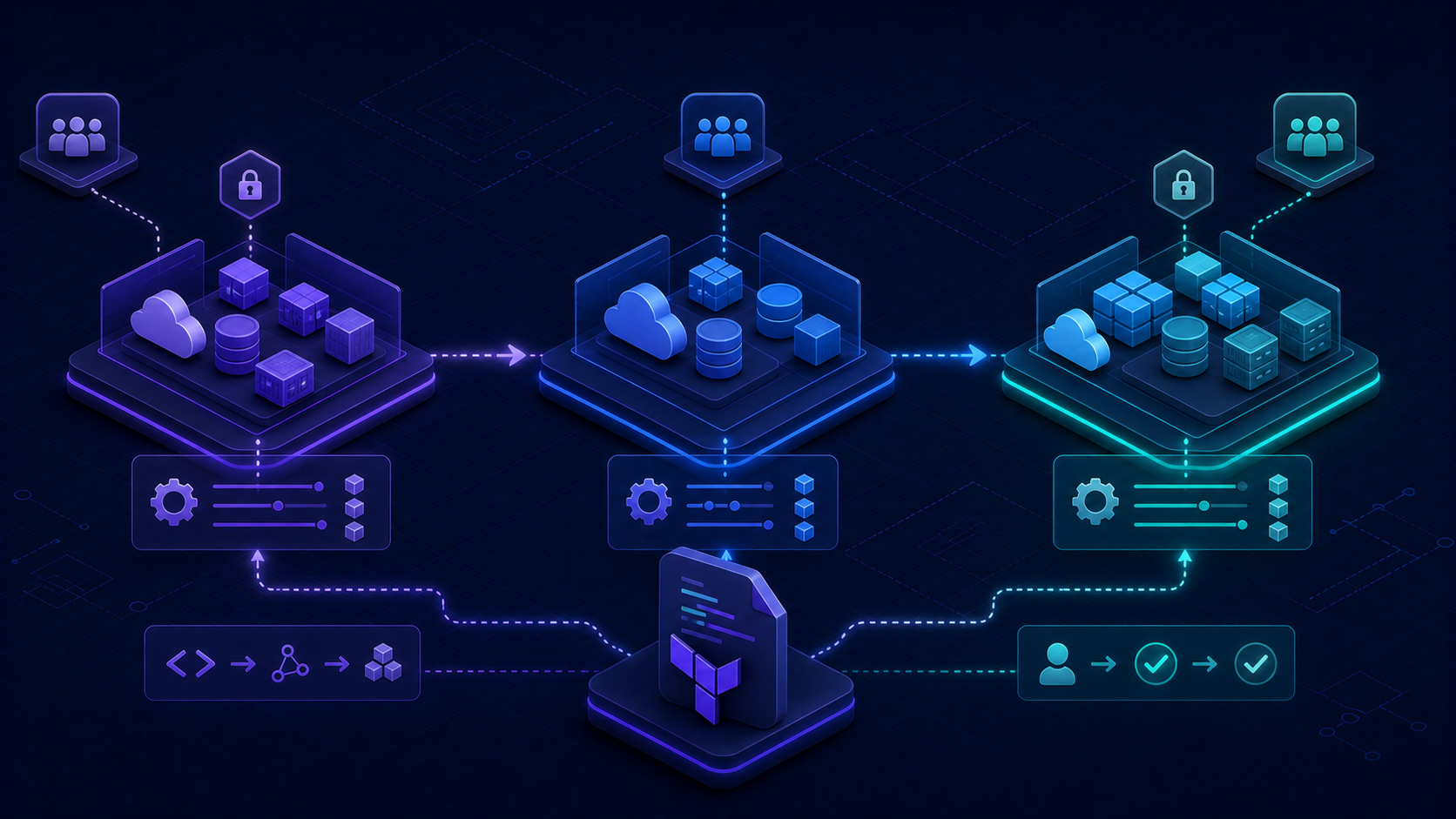
Terraform environments are one of the clearest places where certification topics and workplace practice overlap. Most teams do not run one giant Terraform configuration against everything at once. They need to manage development, staging, and production in a way that is repeatable but still isolated enough to reduce risk.
If you understand how Terraform handles environment separation, you strengthen several exam domains at once: variables, modules, state, workflow, and HCP Terraform.
Why teams separate dev, staging, and production
The reason is simple: risk and confidence. Development environments let teams test ideas faster. Staging helps validate changes in something closer to production. Production needs stronger control, safer changes, and more discipline. Terraform helps because the same core configuration patterns can be reused while still allowing the environments to differ where they need to.
State separation is one of the most important rules
If you remember only one thing about Terraform environments, remember this: separate environments should not share the same state casually. Shared or confused state creates operational risk and makes changes harder to reason about.
That is one reason remote state and backend discipline matter so much. Environment separation is not only a naming convention. It is an operational boundary.
Variables are what make reuse practical
Teams often reuse the same Terraform patterns across environments while changing only selected values such as sizing, naming, endpoints, or feature-specific settings. Variables make that possible. Without variables, teams either duplicate configuration heavily or hard-code values that do not transfer well across environments.
This is also why variables, outputs, and expressions are such an important part of the exam. They are the mechanism that makes multi-environment reuse workable.
Modules help teams keep environment patterns consistent
Modules are another major piece of environment management. Instead of rewriting the same infrastructure layout three different ways, teams can package the common pattern once and call it with environment-specific inputs. That improves consistency and reduces the chance that dev, staging, and prod drift apart for accidental reasons.
For the module side of this topic, see our Terraform modules and providers guide.
Promotion workflows matter as much as configuration reuse
Managing environments well is not only about writing reusable code. It is also about how changes move forward. Teams usually want some version of a promotion path where changes are tested before they reach production. That is where the broader Terraform workflow becomes important: review, plan, and apply are part of safer environment progression.
Where HCP Terraform fits into environment management
HCP Terraform strengthens environment management by adding workspaces, remote runs, governance, and better team coordination. If you are trying to reason about multiple environments in a team context, HCP Terraform is often part of the answer because it gives structure to how environments are organized and operated.
If you need the platform-specific angle, read our HCP Terraform guide.
Common environment mistakes
Here are the mistakes that cause the most trouble:
- Using weak boundaries between environments
- Confusing or reusing state in unsafe ways
- Duplicating too much configuration instead of reusing modules
- Hard-coding values that should vary by environment
- Promoting changes without enough review or validation
How this topic helps on the exam
Environment questions tend to reward integrated thinking. You are not only asked to know what variables are or what state is. You are asked to reason about why those concepts matter when teams operate Terraform across multiple environments.
That is one reason this topic is a good bridge between certification prep and actual workplace understanding. It pulls together several objectives into one practical picture.
FAQ
Why should Terraform environments be separated?
Separate environments reduce risk, support safer testing, and make it easier to control how changes move toward production.
How does Terraform handle different environments?
Teams typically combine separate state, environment-specific variables, reusable modules, and disciplined workflows to manage dev, staging, and production safely.
Does this connect to the Terraform Associate exam?
Yes. Environment management depends on several core exam topics, including variables, modules, state, workflow, and HCP Terraform.
Bottom line
Terraform environments are where many separate exam concepts become one practical operating model. If you can explain how variables, modules, state, and workflow support safer dev, staging, and production management, you are learning Terraform the way teams actually use it.
If you want study material that helps you reason through multi-environment Terraform more quickly, use the Terraform Associate practice tests. They are useful because they make you apply state, variables, modules, and workflow concepts together instead of remembering them as isolated facts.